
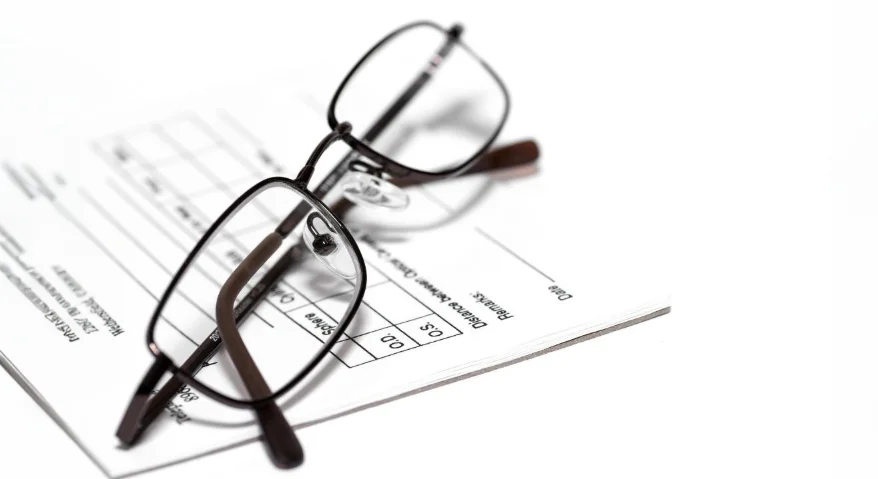
Just received that mysterious slip of paper filled with symbols and numbers from your optometrist? Don't let those abbreviations confuse you. While it may look like a complex secret code, in reality, this data simply provides the optical shop with the precise specifications for the optical correction your eyes require.
Understanding your prescription not only gives you greater confidence when selecting lenses, but it also serves as a fascinating piece of knowledge that helps you gain a clearer picture of your own visual health. In the following sections, we will break down these metrics for you, one by one, using the simplest and most accessible language possible. No medical background is required—in just a few minutes, you’ll be able to interpret your vision needs like a true professional.
Breaking Down Key Eyeglass Prescription Terms
When you receive your eyeglass prescription, you are typically greeted by a chart filled with rows, columns, and various symbols. It is a mix of Latin abbreviations, mathematical signs, and specialized numerical values. To help you get up to speed quickly, we have translated these seemingly arcane terms into plain, easy-to-understand language:
1. Basic Directional Abbreviations (Eye Position)
The most common letters found on a prescription sheet refer to your eyes:
- OD: Stands for *Oculus Dexter* (Right Eye). While the Latin origin sounds academic, you simply need to remember that this section contains the specific data for your right eye.
- OS: Stands for *Oculus Sinister* (Left Eye). This is another directional indicator; it does not reflect the quality of your left eye's vision, but serves solely to distinguish the left side from the right.
- OU: Stands for *Oculus Uterque* (Both Eyes). If you see this term, it indicates that the specified value applies to both eyes.
- DV (Distance Vision): Refers to the corrective power required for viewing distant objects—for instance, when driving or watching a movie.
- NV (Near Vision): Refers to the prescription strength needed for close-range activities, such as reading or using a mobile phone.
- PD (Pupillary Distance): As the name suggests, this is the distance between the centers of your two pupils. This measurement is crucial because it determines whether the geometric center of the lens can be precisely aligned with your pupil. Only when properly aligned will you experience the clearest possible vision. If your doctor did not include this measurement on the prescription sheet, there are now many convenient tools available to help you measure it yourself.
- SPH (Sphere): This value indicates the degree of your nearsightedness (myopia) or farsightedness (hyperopia). The term Sphere implies that the refractive power of the lens is uniform in all directions. In this column, you will see a positive (+) or negative (-) sign followed by a set of numbers; these values directly determine the thickness and curvature of your lenses.
Eye Prescription Scale
When you examine the chart on your eye prescription, you will notice that the Spherical (SPH) or Cylindrical (CYL) columns are filled with numbers preceded by positive or negative signs. These numbers actually represent diopters—the standard unit used to measure the optical power of a lens, much in the same way we use centimeters to measure length.
1. What Exactly Is a Diopter?
Simply put, the magnitude of the diopter value indicates a lens's ability to bend light:
- Larger numbers: This means your eyes require stronger optical correction, and the lenses themselves will often be thicker.
- Smaller numbers: This suggests that your baseline vision is relatively good and requires only minor assistance.
- A value of 0: Congratulations! This indicates that you possess perfect vision for this specific parameter and require no correction.
2. The Minus Sign (-): A Marker for Nearsightedness (Myopia)
If a number is preceded by a minus sign (e.g., -2.50), it indicates that you are nearsighted.
- Visual Experience: You can see nearby objects clearly, but distant objects—such as road signs or writing on a blackboard—will appear blurry.
- Principle: Negative lenses work by diverging light rays, helping to shift images—which would otherwise focus *in front* of the retina—backward to focus precisely on the correct spot.
3. The Plus Sign (+): A Marker for Farsightedness (Hyperopia)
If a number is preceded by a plus sign (e.g., +1.75), it indicates that you are farsighted.
- Visual Experience: You may be able to see distant objects clearly, but prolonged reading of books or viewing screens at close range will feel strenuous, and you may even experience double vision.
- Principle: Positive lenses work by converging light rays, pulling images, which would otherwise focus behind the retina, forward so that they focus exactly upon the retina.
Other Terms on Your Eye Prescription
Beyond the basic measurements for nearsightedness or farsightedness, some people’s prescriptions may feature more advanced terminology. If you notice additional rows of data in your prescription chart, they are typically included to address specific issues such as astigmatism, presbyopia, or eye alignment.
1. Astigmatism Correction: CYL and AXIS
If you have astigmatism, these two values will always appear as a pair:
- Cylinder (CYL): This indicates the degree of your astigmatism. Astigmatism typically occurs because the eyeball is not perfectly round (resembling a football rather than a soccer ball), preventing light from focusing into a single point. If this column is blank, it means you do not have astigmatism.
- Axis (AXIS): This number falls between 1 and 180. It does not represent a power measurement, but rather a direction—telling the technician at what angle the astigmatism-correcting lens should be positioned within the frame.
2. Presbyopia Support: ADD (Add Power)
As we age, reading close-up text can become a strain; this condition is known as presbyopia.
- ADD: This stands for Add Power. It represents a small amount of additional magnification added to your distance vision prescription. With this value, you can be fitted for progressive lenses—a single pair of glasses capable of correcting both distance and near vision simultaneously.
3. Eye Alignment: Prism
For some individuals, the eyes do not work together in perfect synchronization, which can result in double vision or significant visual fatigue.
- Prism: By incorporating a special design into the lenses, prism redirects the angle at which light enters the eyes, helping the images from both eyes fuse into a single, clear image.
- Base: You may see abbreviations such as BU (Base Up), BD (Base Down), BI (Base In), or BO (Base Out). This indicates the direction in which the thickest edge of the lens is oriented—a critical factor in precisely correcting eye alignment.
Don't Forget: Prescriptions Have an Expiration Date
Vision is dynamic and subject to change; therefore, an eyeglass prescription is not valid indefinitely.
- Expiration Date: Most prescriptions are valid for a period of 1 to 2 years.
- Regular Check-ups: Once your prescription expires, you will need to schedule a new eye examination. This is not merely to obtain updated power measurements, but also to monitor the health of the internal structures of your eyes, ensuring your visual system remains in optimal condition.
- Expert Advice: Even if you feel your vision hasn't changed, updating your prescription on schedule can help you identify subtle adjustments that are difficult to detect with the naked eye, thereby preventing eye strain or headaches caused by an inaccurate prescription.
Conclusion
Now that you have mastered this knowledge, there is one final, crucial point to remember: this prescription belongs to you.
According to regulations set by the U.S. Federal Trade Commission, your doctor is obligated to provide you with a complete copy of your prescription immediately after your eye examination. You are under no obligation to purchase your eyewear at the facility where the exam took place, nor is the doctor permitted to charge you an additional fee for requesting your prescription.
We recommend making it a habit to keep a backup of your prescription—whether by snapping a photo to save on your phone or by retaining the original paper copy. With this clear record in hand, finding the perfect pair of glasses becomes effortless—whether you prefer trying on frames at a local optical shop or browsing online for options that offer better value and a wider variety of styles.
Now that you can interpret the meaning behind those numbers like a true professional, your next task is simple: go find the perfect frames that not only ensure crystal-clear vision but also beautifully showcase your unique personal style!
FAQ
Q: Is Your Eye Prescription ''Bad''?
A: During consultations, we frequently hear clients ask: ''Is my prescription too high?'' or ''Is my eyesight really terrible?'' In reality, we prefer to view this issue from a different perspective: there is no absolute distinction between ''good'' and ''bad'' eyesight. Those numbers merely quantify the amount of optical assistance you require to achieve high-definition vision.
What Constitutes a ''Severe'' Vision Issue?
While every individual’s ocular condition is unique, the industry does adhere to certain general benchmarks regarding the severity of vision issues (though definitions may vary slightly across different institutions):
- Regarding Myopia (Nearsightedness): When your correction requirement reaches -5.00 diopters or higher, it is typically classified as high myopia.
- Regarding Hyperopia (Farsightedness): When your prescription reaches +5.25 diopters or higher, it is generally considered high hyperopia.
An interesting phenomenon arises when prescriptions are high: vision issues often cease to be ''unidirectional.'' For instance, individuals with high myopia may struggle not only to see distant objects clearly but also, at times, find reading at close range to be a strain. Conversely, those with severe hyperopia may find that—in addition to the difficulty they experience seeing up close—their clarity of vision at a distance is also compromised. Therefore, the most important mindset to adopt is this: do not judge your eyes as being either ''good'' or ''bad.'' Your eyesight is simply one aspect of your physical makeup; all you need is the right blend of style and technology to unlock your optimal visual potential.
Q: Does my vision prescription change?
A: Simply put: Yes, your vision does indeed change gradually over time.
While drastic fluctuations in vision over a short period are unusual—unless caused by a specific injury, illness, or medical treatment (in which case you should seek immediate medical attention)—a slight and slow drift in your prescription is actually a normal physiological phenomenon, particularly as we age.
1. Why do prescriptions change?
The most common culprit is presbyopia (age-related farsightedness). This typically occurs after the age of 40, as the lens inside the eye gradually loses its elasticity, causing nearby text—such as on a mobile phone or a menu—to appear blurry. At this stage, you may need to acquire a separate pair of reading glasses or upgrade to more convenient progressive lenses.
2. The Importance of Regular Check-ups
Even if you feel your vision is perfectly clear and you experience no eye discomfort, we strongly recommend maintaining an annual comprehensive eye examination:
- Monitor Health: An optometrist does more than just check your prescription; they can also screen for early signs of eye diseases through a retinal examination.
- Fine-tune Parameters: Even a minor change of just 0.25 diopters in your prescription can make a significant difference in alleviating eye strain caused by prolonged visual tasks.
- Ensure Comfort: Regular check-ups ensure your eyewear remains in optimal working condition, helping you avoid headaches or double vision caused by an inaccurate prescription.
Vision is dynamic. Through regular professional examinations, you can ensure that your visual system remains in sync with your lifestyle, allowing you to enjoy lasting clarity and comfort.
Q: Is a contact lens prescription the same as a prescription for eyeglasses?
A: This is a very common question. Many people assume the two are interchangeable, but in reality, contact lens prescriptions and eyeglass prescriptions are two completely different things. If you are planning to try contact lenses, here are the key points you need to know:
1. Why do the numerical values differ?
The fundamental reason lies in distance. Eyeglass lenses sit approximately 12 millimeters away from the eyeball, whereas contact lenses rest directly on the cornea. The elimination of this physical distance means that the requirements for light refraction change; therefore, doctors typically adjust the lens power to account for this difference in distance.
2. Tailor-Made: Unique Measurement Parameters
Much like clothing, contact lenses require specific sizing and a precise fit. In addition to the lens power, a contact lens prescription must include two unique parameters:
- Base Curve (BC): This represents the curvature of the lens. It must perfectly match the natural curvature of your eyeball to ensure a stable and comfortable fit. This value typically falls between 8 and 10 millimeters.
- Diameter (DIA): This refers to the overall width of the lens. An appropriate diameter ensures that the lens covers the correct area of the eye; for most products, this value ranges from 13 to 15 millimeters.
3. Brand Information is Mandatory
Unlike eyeglasses—where you are free to choose any frame you like—a contact lens prescription typically specifies a particular brand name. This is because different manufacturers use varying materials and designs (such as water content and oxygen permeability), and your doctor needs to ensure that the recommended brand is suitable for your specific eye health condition.
4. You Can't Use One Prescription for Both
Please remember: you cannot purchase contact lenses using only an eyeglass prescription. If you wish to try contact lenses, be sure to explicitly inform your doctor when scheduling your eye exam. This ensures that the optometrist performs a specialized contact lens fitting for you, evaluating the lens's fit, comfort, and movement on your eye.
Contact lenses are classified as medical devices. Obtaining a personalized contact lens prescription—complete with specific BC and DIA measurements—is the essential first step toward ensuring comfortable wear and protecting the health of your corneas.


