
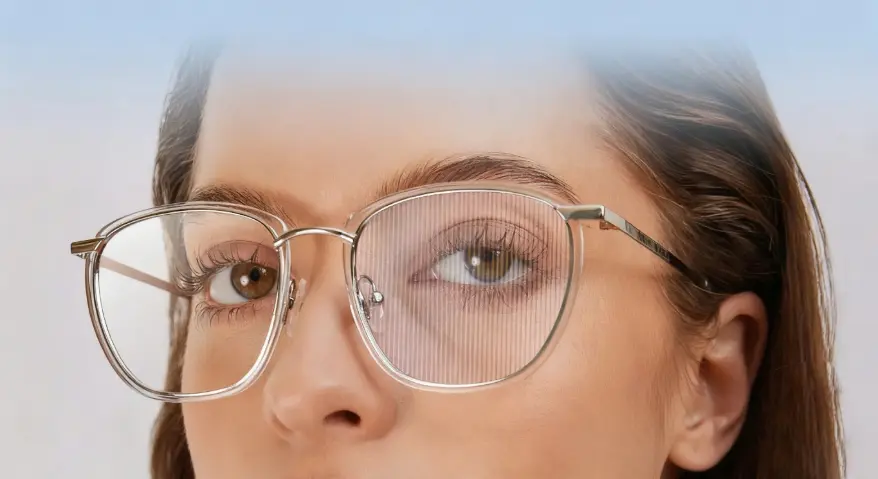
Prism glasses are prescription lenses with a special optical design that redirects light before it enters the eye, helping the eyes to align correctly. Many people know little about these special glasses, unaware that they have become a crucial clinical solution for double vision and related visual impairments. This article will systematically explain how prismatic glasses work, who they are suitable for, and their prescription characteristics, to help you fully understand this professional correction tool.
What Are Prism Glasses?
Prism lenses are specially designed spectacle lenses used to correct vision problems caused by abnormal binocular coordination. Unlike standard eyeglasses, which only address refractive errors like nearsightedness, farsightedness, or astigmatism, prism glasses work by redirecting light to help align the two eyes. When light enters the prism, the images are "shifted" to a point where the brain can properly fuse them, resulting in a clear, aligned image.
This optical adjustment can significantly reduce discomfort symptoms such as double vision (diptyopia), eye strain, and dizziness caused by misaligned images. Prisms are typically made of glass or plastic and can be fused directly into prescription lenses. While they appear indistinguishable from standard glasses, they can functionally address more complex vision problems. For patients with double vision, eye muscle imbalances, or neurologically related eye alignment abnormalities, prism glasses are an effective corrective tool, helping to restore comfortable, stable vision.
How do prism glasses work?
The core principle of prisms is to redirect light. Unlike ordinary lenses, which focus light directly on the retina, prismatic lenses use their unique geometry (thicker at the base and thinner at the top) to bend light before it enters the eye. This "shifts" the misaligned image back to its correct position, allowing both eyes to perceive a single, clear image.
The orientation and power of the prism are determined by the prescription, such as with the base facing up, down, inward, or outward. Each configuration affects how light ultimately strikes the retina. Higher powers bend light more and are suitable for patients with more significant eye misalignment. For mild misalignment, a low-power prism may be sufficient; however, severe double vision caused by neurological conditions may require higher-power prisms.
In clinical practice, prismatic correction can be a long-term solution or a short-term transitional measure. For long-term use, prisms are directly integrated into prescription lenses, creating prismatic eyewear. For temporary correction, Fresnel prisms can be used. These thin, transparent patches can be applied directly to existing lenses for flexible adjustment.
Unlike conventional corrective lenses, prismatic lenses are unique in that they address binocular alignment and coordination, not refractive errors (myopia, hyperopia, astigmatism). Conventional lenses focus light rays to precisely land on the retina; prisms, on the other hand, deflect light, ensuring consistent visual input for both eyes, preventing double vision, eye fatigue, and dizziness. This significantly improves patients' visual quality and overall experience.
Who needs prismatic glasses?
Prismatic glasses are primarily used to correct double vision (diplopia) caused by eye or neurological disorders. When the two eyes are not properly aligned on the same object, light entering the eyes falls on different parts of the retina, resulting in two images. Prismatic lenses redirect light so that the two eyes can merge into a single, clear image, thereby alleviating visual disturbances.
Common conditions requiring prismatic glasses include:
Strabismus (crossed eyes): commonly known as crossed eyes, where the eyes are noticeably misaligned.
Improper binocular coordination, such as convergence deficiency, makes it difficult to focus both eyes simultaneously on close objects.
Diptyia caused by ocular or systemic diseases, such as Graves' disease and myasthenia gravis.
Neurological disorders, including stroke, head trauma, brain tumors, migraines, multiple sclerosis, or diabetes-related nerve damage, can impair eye movement control and cause binocular image misalignment.
It is important to note that prismatic glasses do not correct refractive errors such as nearsightedness, farsightedness, or astigmatism. However, in clinical practice, prisms are often combined with conventional optical prescriptions within the same pair of lenses. For example, lenses designed to correct astigmatism or myopia may be incorporated with prisms, providing comprehensive vision correction while addressing double vision.
In short, prism glasses are suitable for anyone experiencing double vision due to eye muscle dysfunction, neurological conditions, or other visual misalignment issues. With precise fitting, the wearer can not only restore a clear, single image but also effectively alleviate headaches, eye strain, dizziness, and difficulty seeing caused by eye misalignment.
What do prismatic glasses look like?
When many people first hear about "prismatic glasses," they assume they look noticeably different from regular glasses. In reality, once the prisms are incorporated into the lenses, the glasses look almost identical to regular prescription glasses. The optical effect of the prisms is hidden within the lens, making them difficult to detect from the outside.
The main differences in appearance are:
Lens thickness: Because prisms require a specific angle and shape to refract light, they typically make one side of the lens slightly thicker than the other. This thickness difference can be more noticeable with higher prescriptions.
A special case for Fresnel prisms: For temporary correction, your doctor may apply a Fresnel prism over your existing glasses. This thin, transparent film is more noticeable than an embedded prism.
If you're concerned about lens thickness, you can minimize the difference by choosing thicker or darker frames. However, from an optical and wearable perspective, there's no need to limit your frame choices. Prismatic glasses can be paired with a variety of frames to meet your correction needs while also ensuring aesthetics and comfort.
Understanding Your Prism Prescription
When your prescription includes prismatic correction, you'll typically see the corresponding data in a dedicated "Prism" column. These values represent the prismatic diopter (PD), a measure of the power or strength of the prism correction. The higher the value, the greater the prism's ability to bend light.
In addition to the diopter, the prescription also specifies the orientation of the prism's base, which is crucial for determining the direction of light refraction. The base refers to the thickest side of the prism, and its position determines the direction in which light is "shifted." Common abbreviations include:
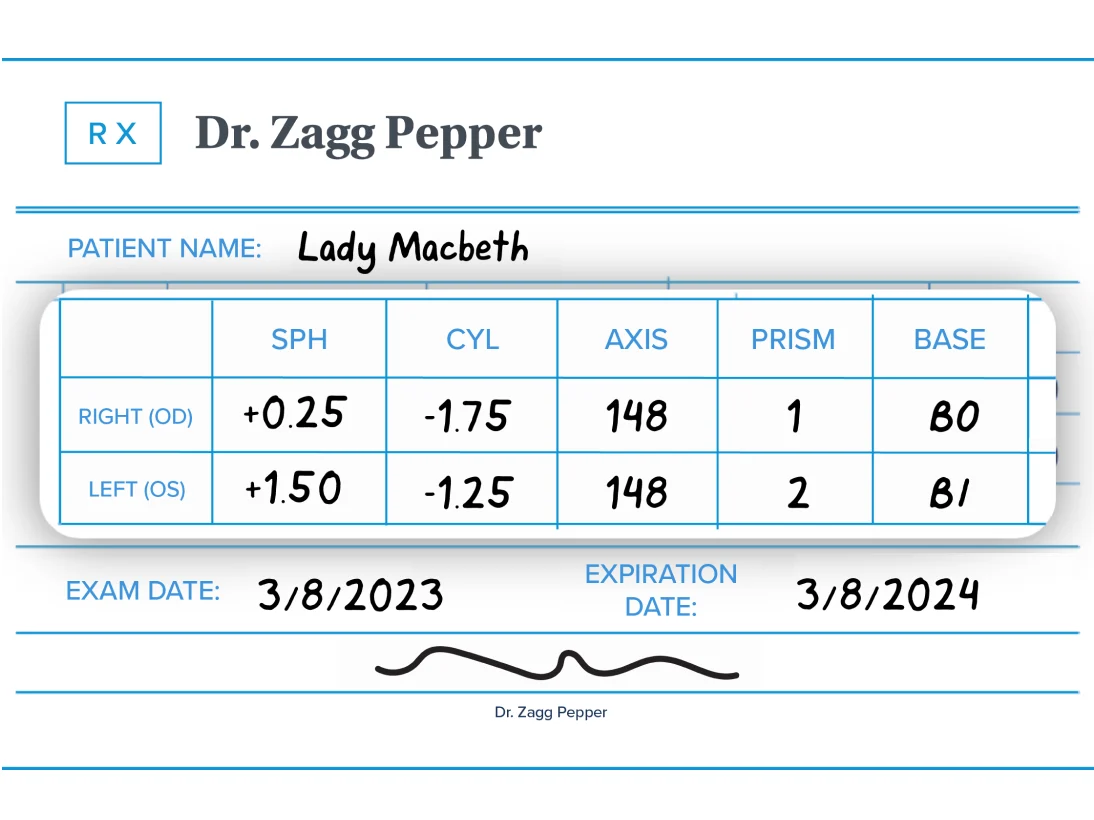
BU (Base Up): With the base facing up, the base of the prism is located at the top edge of the lens.
BD (Base Down): With the prism facing down, the base of the prism is located at the bottom edge of the lens.
BI (Base In): Base facing inward, the base of the prism is located on the side of the lens closest to the bridge of the nose.
BO (Base Out): The base of the prism is positioned outward, facing away from the bridge of the nose, with the base of the prism located on the side of the lens.
By combining the prism's power and base orientation, doctors can precisely adjust the angle of incidence of light, thereby helping the eyes to align properly and improving double vision and related vision problems.
If you've been diagnosed with prismatic correction, it's crucial to undergo an examination or prescription under the guidance of a professional ophthalmologist or optometrist, and to have regular follow-up appointments. Only with scientific evaluation and personalized customization can prismatic glasses truly improve your visual experience and help you regain stable, clear, and comfortable vision. Want to see our best-selling prismatic glasses? Contact customer service and we'll be happy to share.


