
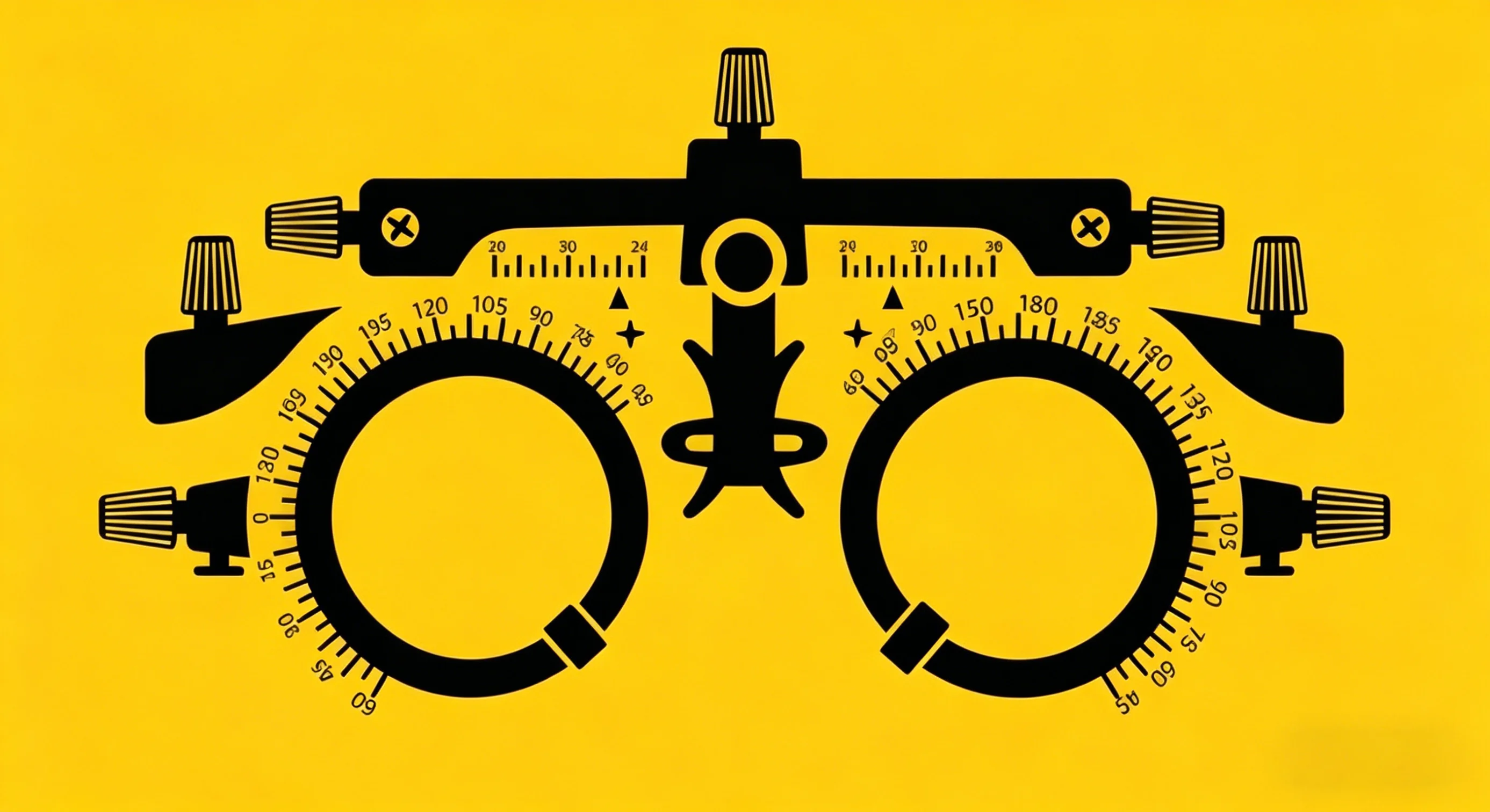
When you receive your vision examination report, the most prominent figure you'll see is the diopter. Simply put, it acts as a measuring scale for vision prescription—specifically designed to quantify the corrective power of eyeglasses or contact lenses.
You can think of it as the working efficiency of a lens:
- A higher value indicates that your eyes require greater power to assist with focusing—what is commonly referred to as having a high prescription.
- A lower value, conversely, suggests a milder vision impairment, requiring only minimal assistance to see the world clearly.
In short, the diopter is the scientific unit used to measure the state of your vision. Curious to uncover the mysteries regarding your eyes that lie hidden behind this enigmatic number? Let us reveal them to you in the simplest, most easy-to-understand way possible.
A Deep Dive: The Science Behind Diopters
To truly understand your vision prescription, we must first unravel the fascinating relationship between diopters (D) and distance. While these terms may sound highly technical, they essentially describe the precision with which our eyes capture light.
1. Focal Length: The Measure of Clarity
In the world of optics, there is a core concept known as focal length. Simply put, it is the distance (measured in meters) from the center of a lens to the specific point where light rays converge perfectly—the point of sharpest focus.
The relationship between diopters and focal length is quite intuitive: the diopter value is the reciprocal of the focal length.
- If a lens has a focal length of 1 meter, its power is 1 diopter.
- If the focal length is shortened to 0.5 meters, its power becomes 2 diopters (i.e., 1 / 0.5).
- Conclusion: The shorter the focal length, the stronger the lens's refractive power (diopter value).
2. Why Do We Need Different Types of Lenses?
For individuals with perfect vision, light rays converge precisely on the retina at the back of the eyeball; in this ideal state, no external assistance is required, and the refractive power is 0 diopters. However, when light rays go astray, we require lenses to correct their path:
Myopia (Nearsightedness): Light Rays Stop Too Soon
In myopic eyes, the focusing power is too strong, causing light rays to converge prematurely—before they even reach the retina.
- Solution: Use a concave lens.
- Principle: This type of lens diverges (spreads out) the light rays, thereby extending the focal length and shifting the focal point backward so that it lands precisely on the retina.
- Indication: A negative sign (-) displayed on the prescription represents the subtraction of excess refractive power.
Hyperopia (Farsightedness): Light Rays Land Too Far Back
In hyperopic eyes, the focusing power is too weak, causing the focal point of the light rays to fall behind the retina.
- Solution: Use a convex lens.
- Principle: This type of lens converges (gathers) the light rays, thereby shortening the focal length and pulling the focal point forward.
- Indication: A positive sign (+) displayed on the prescription represents the addition of supplementary refractive power.
3. Presbyopia: The Natural Challenge of Focusing as We Age
Presbyopia typically begins to manifest after the age of 40. This condition is not caused by a deformation of the eyeball itself, but rather by the gradual loss of elasticity in the eye's internal lens, resulting in an inability to focus effectively on nearby objects—such as when reading.
- The Solution: When examining reading glasses or progressive glasses, you will notice a specific "ADD" (Add Power) value.
- The Principle: Essentially, this value represents an additional positive refractive power added to your existing prescription for distance vision (whether for nearsightedness or farsightedness), providing the necessary magnification to enable clear reading.
- Helpful Tip: While ready-made reading glasses are widely available, it is highly recommended that you consult a professional eye care specialist. Since individual prescriptions—including the power required for each eye and your pupillary distance—can vary significantly, a professional can help you create a customized solution that is perfectly tailored to your specific needs.
Conclusion
Whether you typically wear eyeglasses or contact lenses, your refractive power serves as the crucial metric that ensures you see the world clearly through your lenses. It is more than just a number; it is a focusing solution custom-tailored to your specific eyes.
Since our vision can undergo subtle changes over time, influenced by usage habits and even age, it is essential to schedule regular appointments with an eye care professional for a comprehensive examination. Only through a professional optometric assessment can your precise refractive needs be accurately determined, thereby providing you with a visual experience that is both clear and comfortable.


