
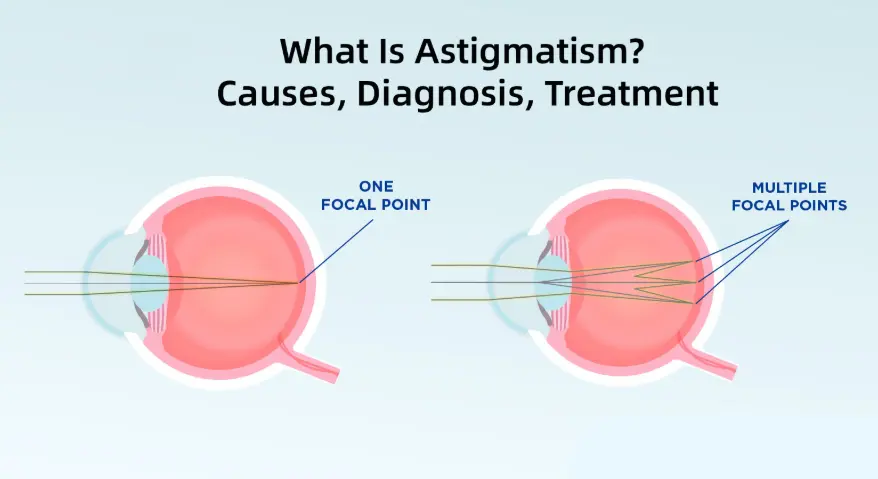
Astigmatism is a common type of refractive error, mainly caused by an irregular curvature of the cornea or the lens. Ideally, the surface of the eye should be shaped like a perfect sphere, allowing incoming light to be evenly refracted and precisely focused onto the retina, resulting in clear vision. However, in people with astigmatism, the cornea or lens is shaped more like a rugby ball or an ellipse, which prevents light from converging evenly on the retina, leading to blurred or distorted vision.
Symptoms of astigmatism include unclear vision at both near and far distances, reduced night vision, eye strain, and headaches. Some individuals are born with astigmatism, and it may coexist with nearsightedness or farsightedness. In fact, most people have mild astigmatism, but when the degree is low, it may not significantly affect daily life.
Fortunately, astigmatism is usually not difficult to correct. It can be diagnosed through a routine eye examination, and depending on the case, vision can be improved with eyeglasses, contact lenses, or refractive surgery. Whichever method is chosen, the vast majority of patients can achieve clear and comfortable vision.
Symptoms of Astigmatism
Common symptoms include:
- Blurred or distorted vision at both near and far distances
- Eye strain when reading or focusing for long periods
- Frequent headaches
- Reduced vision at night or in low-light environments
- The need to squint to see clearly
- Difficulty maintaining concentration for extended periods
- In some cases, double vision
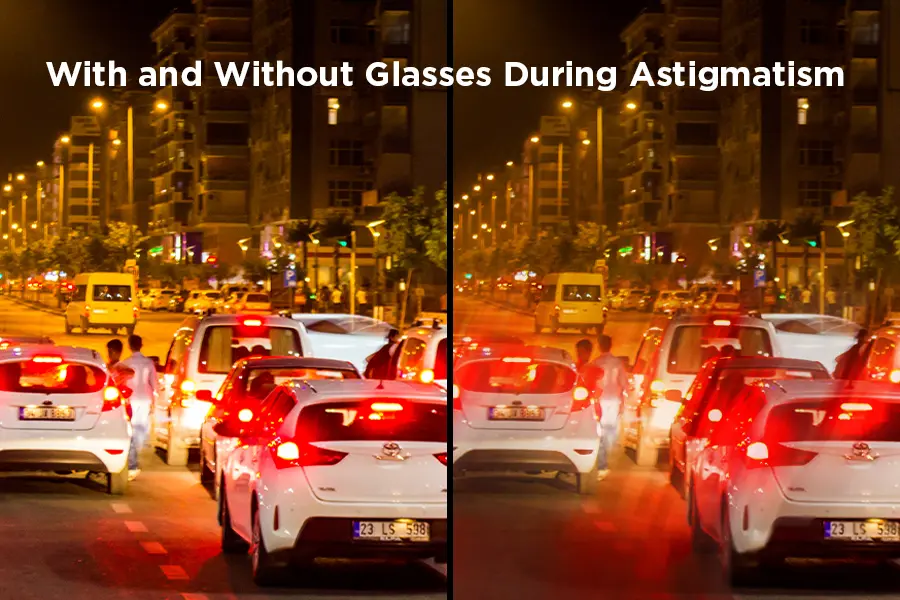
If you often experience these problems, it is recommended to seek timely medical advice. A comprehensive eye examination can help confirm whether astigmatism is present and determine the most suitable correction method.
Types of Astigmatism
The presentation of astigmatism varies from person to person, and even between the two eyes of the same individual, with different degrees and types possible. During an eye examination, an optometrist classifies astigmatism based on its location and the orientation of the curvature.
1. Corneal Astigmatism vs. Lenticular Astigmatism
Corneal astigmatism: The most common type, caused by an uneven curvature of the corneal surface, which prevents light from focusing evenly.
Lenticular astigmatism: Less common, resulting from an irregular shape of the lens inside the eye.
In both cases, the irregular curvature affects how light focuses on the retina, leading to blurred vision.
2. With-the-Rule Astigmatism vs. Against-the-Rule Astigmatism
With-the-rule astigmatism: The cornea is steeper in the vertical direction than in the horizontal direction, similar to a ball compressed from the top and bottom. This is the more common type.
Against-the-rule astigmatism: The opposite condition, where the cornea is steeper horizontally, resembling a rugby ball compressed from the sides.
All types of astigmatism can affect visual quality, but with a professional eye exam and proper corrective measures, most patients can regain clear vision.
Causes of Astigmatism
The main cause of astigmatism is an irregular shape of the cornea or lens, which prevents light from focusing evenly on the retina. Most people are born with astigmatism, though the exact mechanisms behind its development are not fully understood. Current research suggests that genetics plays an important role: if someone in the family has astigmatism, their offspring are more likely to develop it.
In addition to congenital factors, astigmatism can also develop later in life. Eye injuries, surgeries, or certain eye diseases can alter the curvature of the cornea or lens, leading to astigmatism. In rare cases, keratoconus—a condition in which the cornea gradually thins and becomes cone-shaped—can cause more severe astigmatism, often requiring specially designed contact lenses for vision correction.
It is important to note that common concerns such as “reading in dim light” or “sitting too close to the TV” do not cause astigmatism, although they may increase eye strain. Over time and with age, astigmatism may gradually worsen for some patients, while in some children, it may improve as they grow. Regular eye examinations are therefore essential for detecting and managing changes in astigmatism in a timely manner.
Methods for Diagnosing Astigmatism
Astigmatism usually develops gradually. If you notice blurred or distorted vision, it is important to undergo a comprehensive eye examination. Doctors use a variety of tests and instruments to assess how well your eyes focus light and to determine the type and degree of astigmatism.
1. Basic Vision Test
The most common test is the eye chart exam. By reading letters or symbols at a distance, doctors can make an initial assessment of your vision. For example, 20/20 indicates normal vision, while 20/40 means you can see at 20 feet what a person with normal vision can see at 40 feet.
2. Refraction Test and Comprehensive Phoropter Examination
During a refraction test, the doctor uses a phoropter to place lenses of different strengths in front of your eyes and adjusts them to find the clearest vision. This test not only detects astigmatism but also measures nearsightedness or farsightedness, providing an accurate prescription for glasses or contact lenses. Automated refractors can also quickly measure how light bends inside the eye, providing data for calculating the prescription.
3. Corneal Curvature Measurement and Corneal Topography
A keratometer precisely measures the curvature of the central cornea to identify the steepest and flattest curves, providing insight into the cornea’s shape and focusing ability. Corneal topography generates a detailed 3D color map of the cornea, offering the most comprehensive information about its shape. This is especially important for astigmatism correction, contact lens fitting, or preparing for refractive surgery. It can also help diagnose conditions such as keratoconus.
4. Understanding an Astigmatism Prescription
An astigmatism prescription usually includes three components: Spherical (SPH), Cylinder (CYL), and Axis. For example, “OD -1.00 x -2.00 x 155” indicates that the right eye has -1.00 diopters of nearsightedness, -2.00 diopters of astigmatism, with an axis of 155 degrees. These measurements allow doctors to provide precise correction with glasses or contact lenses.
Through these comprehensive examinations, astigmatism can be accurately diagnosed, and the most suitable correction method can be chosen to restore clear and comfortable vision.
Methods for Correcting and Treating Astigmatism
Astigmatism can be corrected through various methods, including glasses, contact lenses, and surgical procedures, all of which can improve visual clarity.
1. Glasses Correction
Wearing prescription glasses is the most common way to correct astigmatism. Astigmatism glasses use cylindrical lenses to precisely bend light onto the retina, reducing blurred or distorted vision. New wearers may need a short adjustment period, but vision typically improves noticeably within a few days to a week.
2. Contact Lens Correction
Toric lenses are specially designed to remain stable on the cornea, preventing rotation that could reduce corrective effectiveness. For more severe astigmatism, scleral lenses or rigid gas-permeable (RGP) lenses can cover irregular areas of the cornea, “correcting” light refraction through the lens shape or the tear layer. Orthokeratology (Ortho-K) uses specially designed rigid lenses worn overnight to gradually reshape the cornea, allowing clear vision during the day without lenses.
3. Surgical Correction
For severe astigmatism or patients wishing to reduce dependence on glasses or contact lenses, laser surgery (such as LASIK and PRK) can reshape the cornea to focus light accurately. The procedure is typically performed under local anesthesia, with a laser adjusting the central corneal layer before repositioning the corneal flap. Additionally, astigmatic keratotomy involves making small incisions in the steepest part of the cornea to improve light focusing. During cataract surgery, astigmatism can also be corrected by implanting a toric intraocular lens.
Overall, there are many effective ways to correct astigmatism. Whether through daily use of glasses or contact lenses, or via surgical intervention, these methods can significantly improve vision, providing patients with clear and comfortable sight.
Ordering Glasses with an Astigmatism Prescription
Through a professional eye exam, an ophthalmologist or optometrist can accurately determine whether you have astigmatism and its severity. If you need glasses or contact lenses to correct astigmatism, you don’t need to worry about limited options. Elklook supports astigmatism corrections up to ±6.00, and most lenses cover this range, giving you a wide selection of frames and styles.
For single-vision lenses correcting severe astigmatism, additional fees may apply due to the more complex manufacturing process. However, for bifocal or progressive lenses, even with high cylinder powers, no extra charge is required. Regardless of your astigmatism level, you can find suitable lenses and frames to achieve precise vision correction while enjoying a stylish and comfortable wearing experience.


