
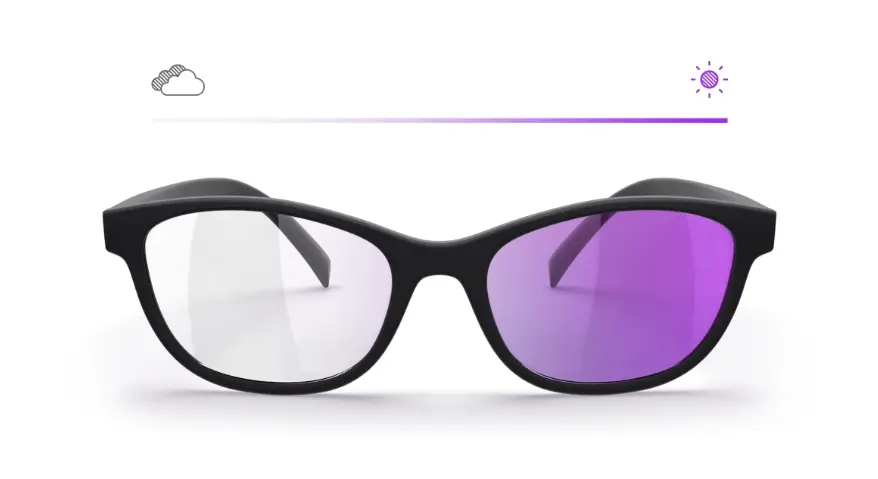
If you wear glasses regularly, you’re probably familiar with the inconvenience caused by strong sunlight. Many people find themselves constantly switching between their regular glasses and sunglasses—putting on sunglasses outdoors, then taking them off and changing back to everyday glasses when going indoors. This constant switching is not only troublesome but also increases the chance of lens wear and tear.
A more efficient and convenient solution is photochromic glasses, also known as “transition glasses.” These glasses automatically adjust their light transmission depending on the brightness of the environment: they quickly darken in strong sunlight or under UV exposure to effectively block harmful rays, and return to a clear, transparent state indoors or in dim lighting, ensuring comfortable and natural vision.
For people who often move between indoor and outdoor settings, photochromic glasses eliminate the hassle of frequently changing eyewear. At the same time, they protect your eyes from UV damage while enhancing comfort, convenience, and safety in daily life and outdoor activities.
What Are Photochromic Glasses?
Photochromic glasses are functional lenses that automatically adjust their light transmission depending on the surrounding light conditions. Indoors or in low-light environments, they remain clear and transparent to meet everyday vision needs. When exposed to sunlight and UV rays, the lenses gradually darken, providing sun protection similar to sunglasses. In other words, with just one pair of glasses, wearers can enjoy the combined benefits of both regular glasses and sunglasses.
This color-changing ability comes from special photochromic dyes embedded in the lenses. When exposed to UV light, the dye molecules undergo a reversible chemical reaction that causes the lenses to darken; once UV exposure decreases, the molecules return to their original state, and the lenses become clear again. Early generations of photochromic lenses only offered a gray tint, but today, options such as gray, brown, and black are available to suit different aesthetic preferences and functional needs.
How Do Photochromic Glasses Work?
Photochromic glasses are functional eyewear that automatically adjust their light transmission based on UV intensity. Indoors or in low-light conditions, they remain transparent. When exposed to UV rays in sunlight, the lenses gradually darken, combining the functions of regular glasses and sunglasses.
1. Basic Mechanism
The core of photochromic glasses lies in their light-sensitive molecules or photochromic layer, which are highly responsive to UV rays:
When UV is present, the molecular structure undergoes a reversible change, absorbing more visible light and darkening the lenses.
When UV disappears, the molecules return to their original state, and the lenses become transparent again.
This process does not require direct sunlight to activate. Even on cloudy days, UV rays penetrate clouds, so the lenses will still darken.
2. Differences Between Plastic and Glass Lenses
Plastic Photochromic Lenses
These contain carbon-based photochromic dyes (such as pyridobenzoxazines and indolinenaphthopyrans). When exposed to UV, the dye molecules break chemical bonds and transform into structures that absorb more visible light, causing the lenses to darken quickly. Compared to glass, plastic lenses react faster and are lighter, making them the mainstream choice in today’s market.
Glass Photochromic Lenses
These primarily rely on silver halide crystals (e.g., silver chloride) embedded in the glass. Under UV exposure, silver ions gain electrons and convert into metallic silver, darkening the lens. When UV decreases, compounds like copper chloride “take back” the electrons, re-oxidizing the silver so the lens clears again. Although glass photochromic lenses have largely been replaced by plastic ones, the technology laid the foundation for later developments in light-responsive lenses.
3. Reaction Speed and Influencing Factors
Reaction Speed: Most photochromic lenses take 30–60 seconds to fully darken under UV exposure, while returning to transparency usually requires 2–3 minutes. Modern innovations continue to improve molecular response rates for faster activation and recovery.
Temperature Effects: At lower temperatures, lenses generally darken more but take longer to clear. At higher temperatures, they darken less but recover more quickly.
4. Service Life
Over time, the responsiveness of photochromic molecules gradually declines. The switching speed between dark and clear states slows, and slight yellowing may occur—signs of lens aging. In general, high-quality photochromic lenses can maintain good performance for 3 years or longer.
Pros and Cons of Photochromic Glasses
So, are photochromic glasses worth buying? We've compiled the pros and cons below to help you decide.
Advantages of Photochromic Glasses
1. Convenience of “two-in-one” eyewear
With photochromic glasses, there’s no need to switch back and forth between regular glasses and sunglasses. A single pair of lenses can meet multiple needs, reducing the hassle of carrying extra eyewear and lowering the risk of loss or damage.
2. Cost-effectiveness
Compared to purchasing both prescription glasses and prescription sunglasses, photochromic glasses are often more economical in the long run. Although their upfront cost is slightly higher, they can save money on extra frames and lenses.
3. Excellent UV protection
Photochromic lenses block 100% of UVA and UVB rays, helping reduce the risk of eye conditions caused by prolonged UV exposure, such as cataracts and photokeratitis.
4. Blue light and glare reduction
Many high-quality photochromic lenses also filter some harmful blue light from screens and sunlight. They reduce glare from bright light, improving overall visual comfort.
5. Lightweight and durable materials
Modern photochromic glasses are often made from lightweight materials such as polycarbonate or Trivex. They are comfortable to wear, impact-resistant, and scratch-resistant. Since photochromic molecules are embedded within the lens material, they won’t wear off from everyday cleaning.
6. Style and personalization
No longer limited to traditional gray, photochromic lenses now come in brown, green, and other tints, offering more choices to match personal style and functional needs.
7. Ideal for children and active lifestyles
For children who need vision correction or individuals who spend a lot of time outdoors, photochromic glasses reduce the inconvenience of carrying multiple pairs of glasses while improving both safety and convenience.
Disadvantages of Photochromic Glasses
1. Limited reaction speed
It typically takes 30–60 seconds for lenses to fully darken and 2–3 minutes to return to clear. In situations where rapid light adjustment is needed, some users may find this response too slow.
2. Limitations while driving
Since modern car windshields are designed to block UV rays, they may also block the light that triggers darkening. As a result, many photochromic lenses do not darken fully inside vehicles, limiting their glare-reduction effectiveness while driving.
3. Temperature sensitivity
In cold conditions, lenses usually darken more but take longer to clear. In hot conditions, they may not darken as much, though they return to clear more quickly.
4. Variations in darkness levels
Different brands and materials produce varying levels of lens darkness. Some users may find them too light to block strong sunlight effectively, while others may feel they darken too much, affecting indoor visibility.
5. Aging and lifespan
Over time, the responsiveness of photochromic molecules decreases. The transition between light and dark becomes slower, and lenses may develop a slight yellow tint. Generally, high-quality photochromic lenses maintain good performance for around 3 years or longer.
Which Type of Photochromic Glasses Is Right for You?
Photochromic lenses can be applied to nearly all common types of eyewear, catering to different vision needs and lifestyles:
Single-vision photochromic lenses: Ideal for nearsighted or farsighted wearers, providing clear vision while offering UV protection for everyday use.
Progressive photochromic lenses: Offer a full range of clear vision at near, intermediate, and far distances, perfect for those who want to avoid constantly switching glasses.
Presbyopia photochromic lenses: Designed for older adults, these lenses support reading while also protecting the eyes from sunlight outdoors.
Non-prescription photochromic glasses: Suitable for people who don’t need vision correction but want UV protection, such as frequent outdoor enthusiasts or drivers.
High-index photochromic lenses: Provide a lighter and thinner option for those with higher prescriptions while retaining the photochromic function.
Choosing the Best Glasses
Many people want their eyewear to combine clear vision with style and convenience. For such needs, photochromic lenses are an ideal choice.
At Elklook, you can select photochromic lenses for regular glasses and even customize your prescription for a personalized visual solution. If you prefer a dedicated pair of prescription sunglasses, simply choose polarized or dark-tinted lenses when selecting your frames. This way, you can maintain your personal style while saving on additional costs.


