
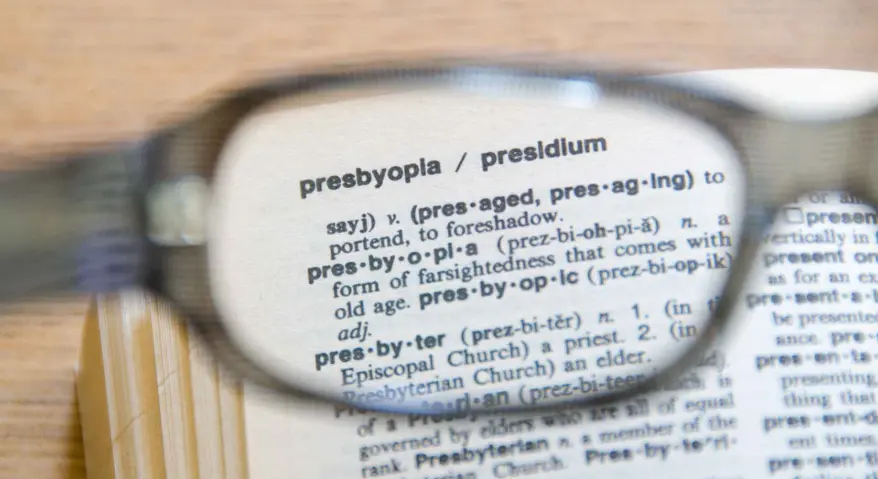
Presbyopia is a normal physiological phenomenon that gradually occurs with age, characterized by the loss of the eye’s ability to see nearby objects clearly. It usually becomes noticeable after the age of 40, progressively worsens between 45 and 65, and then tends to stabilize. The fundamental cause is the decline in the elasticity of the crystalline lens and the weakening of the ciliary muscle’s accommodative function, which makes it difficult for the eye to adjust focus as smoothly as it did in youth, resulting in blurred near vision.
Typical symptoms include needing to hold reading material or a phone farther away, blurred near vision, eye strain or headaches after prolonged close-up work, and increased difficulty seeing near objects in dim lighting. Many people first notice presbyopia when they have to hold a newspaper or book at arm’s length.
It is important to note that presbyopia is not the same as hyperopia (farsightedness). Hyperopia is a refractive error primarily caused by abnormal eye length or corneal curvature, while presbyopia is an age-related natural change that almost everyone will experience. Therefore, presbyopia is not considered a disease, but rather an inevitable visual change that occurs with aging.
Presbyopia Causes
Presbyopia mainly results from the gradual loss of elasticity in the eye’s crystalline lens and the decline in the efficiency of the ciliary muscle. The crystalline lens, located behind the iris, is a transparent, biconvex structure that functions like a camera lens. It changes shape depending on viewing distance, allowing light to focus accurately on the retina and form clear images.
In youth, the lens is soft and flexible, capable of rapid shape changes that let us clearly see both near and distant objects. However, as we age, the lens becomes thicker and harder, with new cell layers stacking up like the layers of an onion, gradually reducing its flexibility. At the same time, although the ciliary muscle can still contract and relax, it is no longer able to adjust the lens as effectively as before, making it difficult for light to focus properly on the retina.
This age-related change usually starts to appear after the age of 40. The most noticeable symptom is difficulty with near tasks such as reading, sewing, or using a smartphone, often requiring objects to be held farther away to see clearly. As aging progresses, near vision continues to blur and may be accompanied by eye strain and headaches. Although presbyopia cannot be prevented or reversed through lifestyle habits, it can be effectively corrected with eyeglasses, contact lenses, medication, or surgery.
Differences Between Presbyopia, Myopia, and Hyperopia
Presbyopia is often mistaken for nearsightedness or farsightedness, but the three conditions differ in both causes and symptoms.
Presbyopia is an age-related natural change that usually becomes noticeable after age 40. Its root cause is the thickening and loss of elasticity of the crystalline lens, which reduces its ability to change shape and properly focus light. As a result, near vision becomes blurry, and people often need to hold books or phones farther away to see clearly.
Hyperopia (farsightedness) is unrelated to age and is usually due to structural characteristics of the eye. When the eyeball is too short or the corneal curvature is too flat, incoming light focuses behind the retina. This makes it difficult to see nearby objects clearly and, in some cases, even distant vision may be affected. Hyperopia can appear in childhood or adolescence and may be inherited.
Myopia (nearsightedness) is the opposite of hyperopia. It is typically caused by an eyeball that is too long or a cornea that is too steeply curved, which makes light focus in front of the retina. This results in distant objects appearing blurry, while near objects remain clear. Myopia usually develops during childhood or adolescence and may worsen over time.
It is important to note that presbyopia is not simply an “extension” of either nearsightedness or farsightedness. Instead, it is a distinct type of refractive error. In fact, presbyopia can occur alongside myopia, hyperopia, or astigmatism. For example, a person with nearsightedness may still develop presbyopia in middle age, requiring a more complex and personalized eyeglass prescription to meet vision needs at different distances.
Common Symptoms of Presbyopia
You may be experiencing presbyopia if you notice the following:
- Blurred text or nearby objects at a normal reading distance
- Needing to hold books, phones, or newspapers at arm’s length to see clearly
- Eye strain, discomfort, or headaches after prolonged reading or close-up work
- Requiring more light than usual when reading or doing fine tasks
- Symptoms worsen when tired or in dim lighting
- Unstable vision, needing to squint or adjust posture to achieve clarity
How Is Presbyopia Diagnosed?
Eye examination: An ophthalmologist or optometrist will conduct a comprehensive vision test to assess both near and distance vision.
Refraction test: Specialized equipment is used to measure how light is refracted in the eye, confirming the presence of presbyopia.
Comprehensive evaluation: The diagnosis and correction plan are based on symptoms, age, and overall eye health.
Even if you don’t have obvious symptoms, regular eye exams are essential to detect presbyopia early and to monitor for other potential eye conditions.
Treatments for Presbyopia
As presbyopia develops, there are several ways to improve near vision, making reading, using a smartphone, or performing fine tasks easier.
Reading Glasses
Reading glasses are specifically designed for near vision, using built-in magnifying lenses to help you see text and details more clearly. Over-the-counter reading glasses are available at pharmacies or retail stores, usually ranging from +1.00 to +2.75 diopters. However, these are general-purpose and cannot address differences between the left and right eyes or conditions like astigmatism. For more accurate and comfortable correction, it is recommended to have prescription single-vision reading glasses fitted after a professional eye exam. Prescription reading glasses can be customized for individual vision needs and account for other visual issues such as astigmatism, providing a more precise and comfortable reading experience.
Multifocal Glasses
If you want a single pair of glasses to meet your distance, intermediate, and near vision needs, consider multifocal lenses:
Progressive glasses: These have no visible dividing lines, with a smooth transition from distance to near vision. They are both aesthetically pleasing and practical, allowing easy reading and working at different distances—ideal for daily life and computer use.
Bifocal glasses: Each lens has two distinct areas—top for distance vision and bottom for near vision, separated by a visible line, making it easy to switch between tasks at varying distances.
Trifocal glasses: Based on bifocals, they add an intermediate vision zone, providing clear correction for near, intermediate, and far distances—perfect for users who frequently switch focus between different distances.
Choosing the right presbyopia correction method can significantly improve near vision, relieve eye strain and headaches caused by prolonged close-up work, and enhance daily life and work efficiency.
Surgical Treatments for Presbyopia
For those who wish to reduce dependence on glasses or contact lenses, surgical options provide a long-term solution, although they tend to be more costly.
Refractive Surgery
Common refractive procedures, such as LASIK, improve vision by reshaping the cornea. Some surgical methods can even mimic the effect of monovision contact lenses—correcting one eye for distance vision and the other for near vision—allowing adults to see clearly at both near and far distances. This approach is suitable for adults seeking to minimize the impact of presbyopia, but it requires evaluation and operation by an experienced ophthalmologist.
Corneal Inlays
Corneal inlays are tiny implants inserted into the cornea of the non-dominant eye by a surgeon, functioning like a miniature aperture. They improve near vision while minimally affecting distance vision, offering another option for patients who want to maintain clear vision at multiple distances.
Risk Factors for Presbyopia
In addition to age, certain health conditions and diseases may increase the likelihood of developing presbyopia earlier. For example, individuals with hyperopia, diabetes, multiple sclerosis, or cardiovascular diseases may experience presbyopia symptoms before the age of 40.
Additionally, some medications can affect the eye’s focusing ability, worsening or accelerating the onset of presbyopia. These include certain antidepressants, antihistamines, and diuretics.
Being aware of these risk factors can help you monitor changes in your vision early, seek timely corrective measures, and have regular eye exams to maintain clear vision in daily life.
Presbyopia is a natural physiological change, but with timely correction, you can still maintain good everyday vision. Reading glasses, progressive multifocal lenses, or other corrective methods can help you see clearly during near tasks and reading. Regular eye exams help monitor changes in your vision and ensure that you receive the most suitable correction.


